
Use Greenleaf’s principles of servant leadership in “What Is Servant Leadership?” and the Bible passages in “Biblical Servant Leadership References” for this assignment

Use Greenleaf’s principles of servant leadership in “What Is Servant Leadership?” and the Bible passages in “Biblical Servant Leadership References” for this assignment.
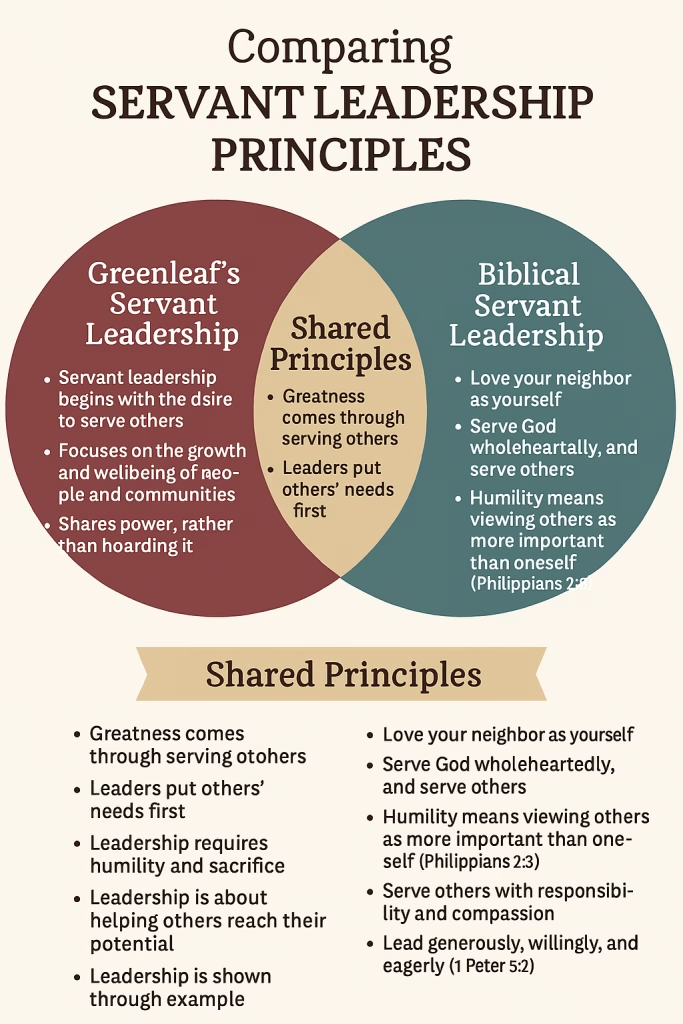
Create a graphic representation to illustrate the similarities and differences between the servant leadership principles of Greenleaf and those in the Bible passages.
Write at least 750-word summary of how both Greenleaf and the Bible call people to serve, and discuss how one feels when called to serve as a leader. In your summary, include discussion of the following:
- Similarities and differences between Greenleaf’s servant leadership and the Bible passages.
- Describe how this will impact your personal approach to leadership.
- The idea that power comes from giving it away and putting oneself in the position to serve others. Using Matthew 20:20-28 and Greenleaf’s principles of servant leadership as a basis, explain how taking the role of a servant can make one a leader.
Provide specific examples from scripture and supporting citations from the readings related to Greenleaf’s principles of servant leadership to strengthen your ideas and claims.
Submit your graphic representation and written response as a single Word document, not as a PDF.
While APA style is not required for the body of this assignment, solid academic writing is expected, and documentation of sources should be presented using APA formatting guidelines, which can be found in the APA Style Guide, located in the Student Success Center.
This assignment uses a rubric. Please review the rubric prior to beginning the assignment to become familiar with the expectations for successful completion.
You are required to submit this assignment to LopesWrite. A link to the LopesWrite technical support articles is located in Class Resources if you need assistance.
Benchmark Information
This benchmark assignment assesses the following programmatic competencies:
MS-Leadership
4.1: Interpret Christian perspectives of leadership through the analysis of biblical passages.
MBA-MSL
7.1: Interpret Christian perspectives of leadership through the analysis of biblical passages.
Expert Answer and Explanation
Servant Leadership and Christianity
Different leaders have different styles of leadership that they manifest to motivate their subordinates to action. One of those styles is servant leadership. Servant leadership is a leadership philosophy that emphasizes putting the needs of others first and empowering individuals to grow and succeed (Demeke et al., 2024). This approach, developed by Robert K. Greenleaf, although, its roots can be traced back earlier from the Bible, with Jesus Christ being an embodiment of true servant leadership. As depicted in Mathew 20:26. At its core, servant leadership challenges traditional leadership models by shifting the focus from power and authority to service and selflessness.
This paper will explore the connection between Greenleaf’s principles and Biblical teachings on service, specifically in Matthew 20:20-28, which calls believers to adopt a servant’s heart in leadership. It will examine the similarities and differences between Greenleaf’s philosophy and the Bible, discuss how this perspective reshapes leadership, and reflect on how it will impact my personal approach to leading others.
Graphic Representation Comparing Servant Leadership Principles of Greenleaf and Bible
Comparing the two descriptions of servant leadership between Greenleaf’s principles and Biblical teachings, there are several aspects that appear similar; one of those aspects is the concept of service. Both Greenleaf and Scripture emphasize that leadership begins with serving others, with Greenleaf stating that being a servant leader begins with serving others first (Greenleaf Center for Servant Leadership, n.d.), while Jesus teaches the same in Mark 10:43.
There is also the aspect of humility that both regard as essential to empowering others, which is noted by Greenleaf and in Philippians 2:3–4. Greenleaf’s model encourages empowering others in servant leadership and the Bible echoes this in 1 Peter 4:10, which calls believers to use their gifts in the service of others. Other similarities include leading by example and making the focus to being of service to others.
Some of the differences include the goal of servant leadership, where Greenleaf emphasizes personal growth and institutional renewal, while the Bible in Philippians 2:5-11, placing servant leadership as not only a platform to empower others, but also for spiritual growth and glorifying God. The other difference is the source of authority where Greenleaf states it being rooted in one’s personal choice to serve (Greenleaf Center for Servant Leadership, n.d.), while the Bible mentioning it being rooted in divine calling and obedience to God as seen in Deuteronomy 10:12; Acts 20:28.
The third aspect is its application context, where Greenleaf shows its application in secular and organizational contexts, while the Bible is centered on Christ’s example and teachings as seen in John 13:13-15. Greenleaf defines the role of servant leadership as a way of regenerating the society, while the Bible calls servant leaders to serve the flock with care (New International Version, 2011, Acts 20:28).
Impact on Personal Approach to Servant Leadership
The distinction between the two leadership approaches has shifted my thinking on what the main motivation of leadership shpuld be. Motivation to lead should be based on the intent to serve others in love, humility, and purpose. In this case, serving others should be a selfless endeavor as called in Mathew 20, and not as a way of amassing power or personal benefits.
Another way the perspectives shared in the Bible will impact my personal approach to leadership is the fact that leadership is viewed as a noble calling from God as seen in Acts 20:28. Therefore, the level of diligence and care needed to discharge my duties as a leader should be on a higher level. Acts 20:28 calls leaders to “care for the church of God, showing that leadership extends beyond personal motives and tasks to carefully nurturing relationships and fulfilling God’s purpose for mankind.
The distinctions shared further cements the need to model Christ-like leadership by embodying the values I teach, serving with integrity, compassion, and consistency. Just as Jesus said John 13:15. My actions as a leader should become a living testimony of servant leadership. Greenleaf also emphasized that servant-leaders lead by example, inspiring others through their behavior rather than commands.
How Role of a Servant Makes a Leader
If there is one agreement from Greenleaf’s text and the Bible is that power comes through service. Both Matthew 20:20-28 and Greenleaf’s servant leadership emphasize that true leadership comes from serving others, not exerting control. By prioritizing the needs of others, a leader gains respect, trust, and influence (Demeke et al., 2024). Therefore, the motivation to lead should come from ones service and not desire to command others.
Servanthood as leadership is a foundational principle shared by both Jesus and Robert Greenleaf. In Matthew 20:26–28, Jesus teaches that “whoever wants to become great among you must be your servant,” redefining greatness not by status or authority, but by one’s willingness to serve others. This radical inversion of power aligns closely with Greenleaf’s philosophy, which asserts that true leaders are servants first, choosing to lead only after committing to the growth and well-being of others (Greenleaf Center for Servant Leadership, n.d.).
Both perspectives emphasize that leadership is not about control or dominance, but about empowering others, fostering trust, and cultivating a collaborative environment where people feel supported and valued. By placing servanthood at the heart of leadership, both models challenge conventional hierarchies and invite leaders to prioritize humility, compassion, and shared purpose.
Adopting the role of a servant transforms leadership by shifting the focus from personal power to the well-being and development of others. Servant leaders are not driven by a desire for personal recognition or control; instead, they actively seek to empower those around them. This focus on humility and support creates an environment where individuals feel valued, heard, and encouraged to grow. Similarly, by prioritizing the needs of others, servant leaders cultivate trust and loyalty, which leads to a more collaborative, engaged, and motivated team.
This shift in leadership approach creates a sense of community and shared purpose, ultimately leading to a culture where everyone is uplifted and has the opportunity to thrive (Demeke et al., 2024). Through this selfless approach, servant leaders can inspire others to adopt similar behaviors, driving long-term positive change within organizations and communities.
Conclusion
Servant leadership, whether viewed through Greenleaf’s organizational lens or the biblical teachings of Jesus, offers a transformative model that focuses on humility, service, and empowerment. Both perspectives challenge traditional notions of authority by placing the needs of others at the center of leadership. This approach not only helps to nurture personal growth and institutional renewal but also aligns leadership with spiritual purpose and relational care. Ultimately, servant leadership cultivates environments of trust, collaboration, and shared purpose, where individuals and communities can flourish.
References
Demeke, G. W., van Engen, M. L., & Markos, S. (2024). Servant leadership in the healthcare literature: A systematic review. Journal of healthcare leadership, 16, 1–14. https://doi.org/10.2147/JHL.S440160
Greenleaf Center for Servant Leadership. (n.d.). What is servant leadership? https://greenleaf.org/what-is-servant-leadership/
New International Version Bible. (2011). Zondervan Publishing (Original work published 1978).


I am a professional nursing assignment expert offering comprehensive academic support to university nursing students across various institutions. My services are designed to help learners manage their workload effectively while maintaining academic excellence. With years of experience in nursing research, case study writing, and evidence-based reporting, I ensure every paper is original, well-researched, and aligned with current academic standards.
My goal is to provide dependable academic assistance that enables students to focus on practical training and career growth.
Contact me today to receive expert guidance and timely, high-quality nursing assignment help tailored to your academic needs.